Interior dimensions were about 250x250x250cm (8’ x 8’ x 8’). It has a typical American two bench setup with foot at ≈46 (18”) high and sitting at ≈94 (37”) high. Top of stones for the Kuuma is 81cm (32”) so feet are 36 (14”) below the top of the stones. Cold zone is at 84 so feet are 38 below the top of the cold zone.
There was no commons/changing space so the sauna door opened directly to outside. This wasn’t a problem on our very pleasant September day but would be during winter.
Ventilation was via gaps in the floor. I was not able to accurately measure CO2. It was definitely higher than it should be causing the sauna to feel stuffier than it should but it wasn’t terrible.
Outside temperature was 20°c, DP 12.24, RH 61%, partly cloudy.
Average head temp was a pleasant 93°c, average foot temp was 56°c. Toes were 40% cooler than head so considerably worse than the 20% desired for a good sauna.
Tcore estimated to have been an increase of about 0.8 – 1.0°c for a 15 minute round (assuming 2 large ladles of steam). This results in a less enjoyable cold plunge than a higher Tcore and is below the 1.1°c increase threshold currently believed to be needed for most health/wellness/recovery benefits.
Overall location was quite wonderful. Kind of open woods with adequate privacy that bathers can be nude in the sauna and the cold plunge outside. Host/owner was similarly wonderful and did a good job of explaining everything and getting us going. There were no showers. Changing was on the porch. This could perhaps be described as a rustic sauna.
The hot room experience was one of cold feet due to too much heat and steam stratification along with steam that stings. Very noticable radiant from the stove. We had an enjoyable day here but a real sauna would have been a better experience.
Technical Analysis
Not unexpectedly, and like all Kuuma’s we’ve seen, the stones weren’t very hot. The hottest I found was 146°c while most were 97-108°c. Stones need to be a minimum of about 120°c to make steam with about 150-300 the desirable range for good löyly. Similar to other Kuuma’s this resulted in steel steam (from the top of the fire box instead of stone) that stings and was ‘biting’ rather than the gentle but intense steam that is generally most desirable in a sauna.
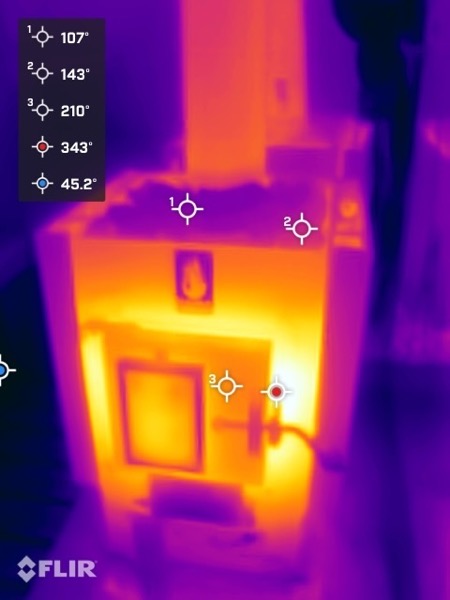
The heat shields work OK from the sides. We still felt a lot of radiant on our faces and lower legs from every seating position however. As Lassi noted, this probably from the face of the stove that has a lot of very hot thick steel. The flue @ 164°c might have produced a little bit of noticeable radiant as well though likely very minimal.
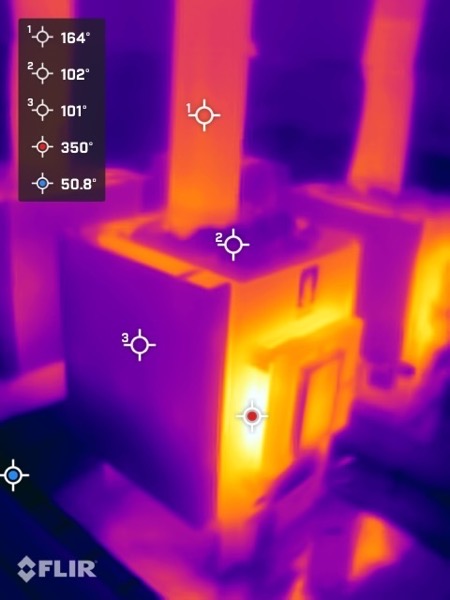
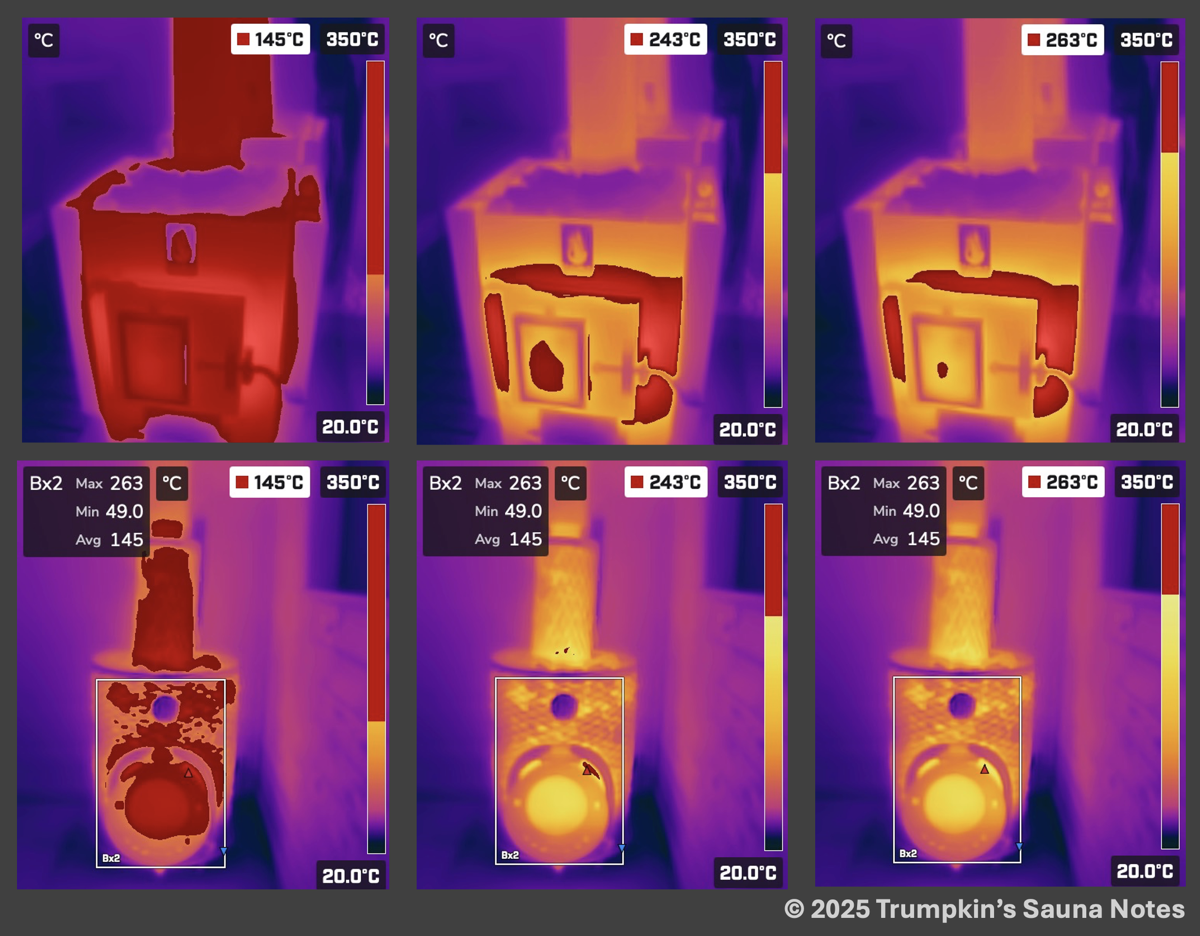
In comparison, an Iki Original has hotter stones and produces less radiant for a similar sauna head temp (90°c when this image was done). Note that the hottest point w/ this Iki is 261°c down in the stones near the flue. The Kuuma is a higher 350°c on its face which is also a large area of steel plate on the front.

Here’s a comparison of the heat produced by the face of an Iki vs Kuuma.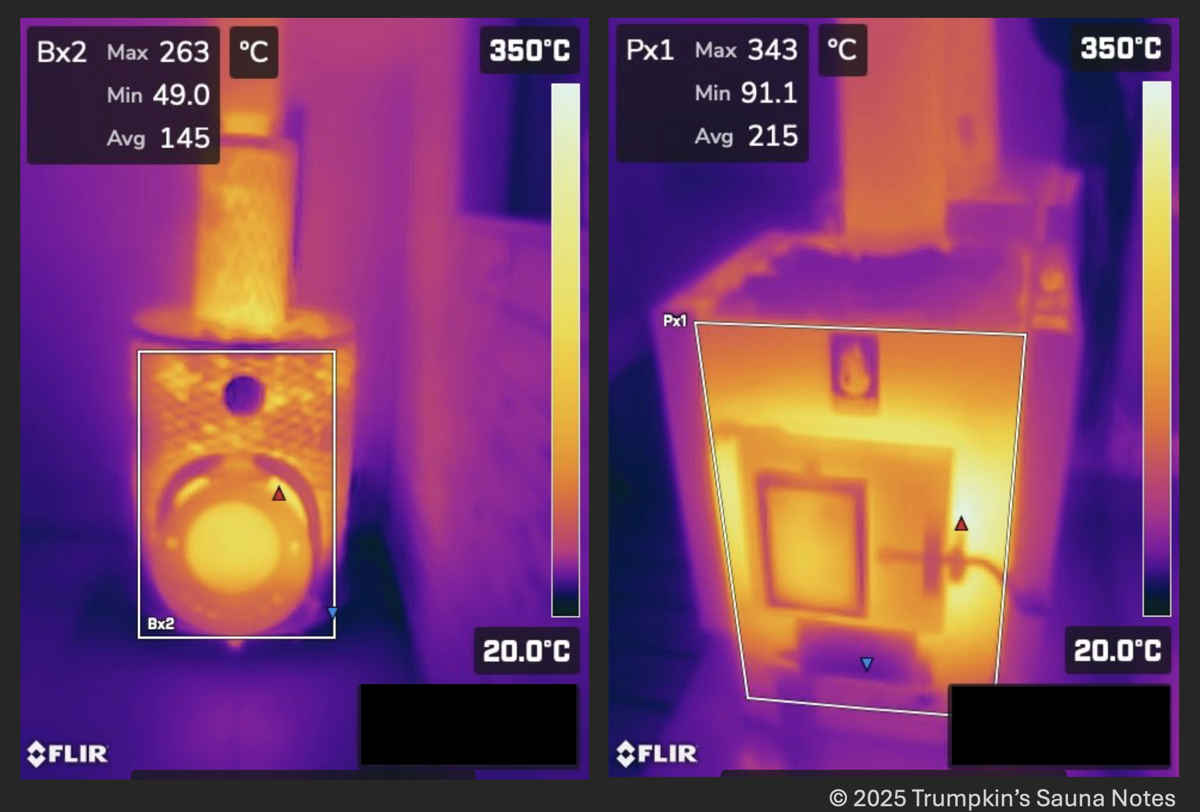
While an Iki produces much less radiant generally, the real standout is comparing how little of the Iki produces anything 243°c or higher compared to how much of the Kuuma is over 263°c. 263 is the hottest point on the Iki.
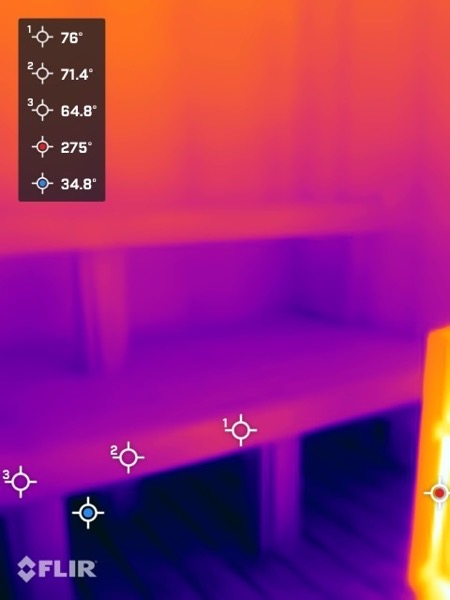
In these next two images we can see the radiant along the front of the foot bench with the signature radiant horizontal falloff. FWIW, the ambient air temp @ about 5cm above the foot bench was 58°c.
This first one shows the Kuuma stove and part of the foot bench. In a normal sauna with less radiant from the heater the temps along the front of the foot bench will largely be identical across the entire width and the same as the ambient air temperature. So here these would all have all been ≈ 56.5°c. The hottest point on the face was 81°c according to FLIR so about 24°c (43°f) of radiant.
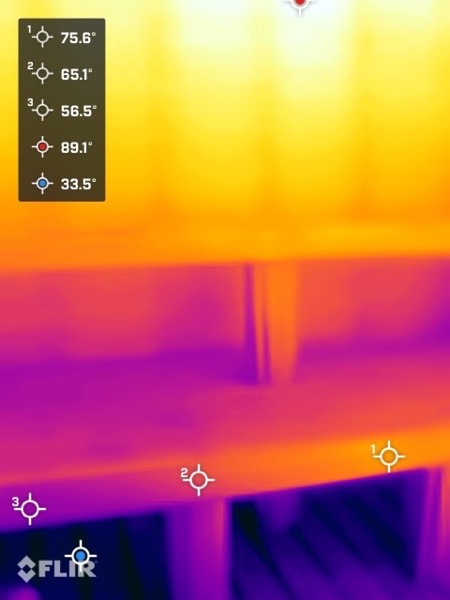
This second one shows a wider view of the foot bench. Point #1 is approximately the same in this and the prior image (color scales are different). The falloff from 75.6°c to 56.5°c is greater than would be expected based on inverse square law calculations which indicate about 71°c for this distance rather than 56.5. This however is due to the oblique angle.
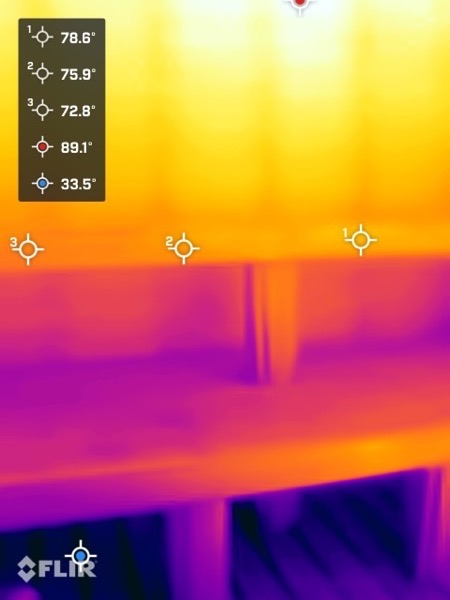
And here the temps on the face of the sitting bench. Again we see the telltale radiant signature of horizontal falloff as we get further from the stove. I was surprised there was this much effect from radiant here. The hotter ambient temps here moderate the falloff somewhat.
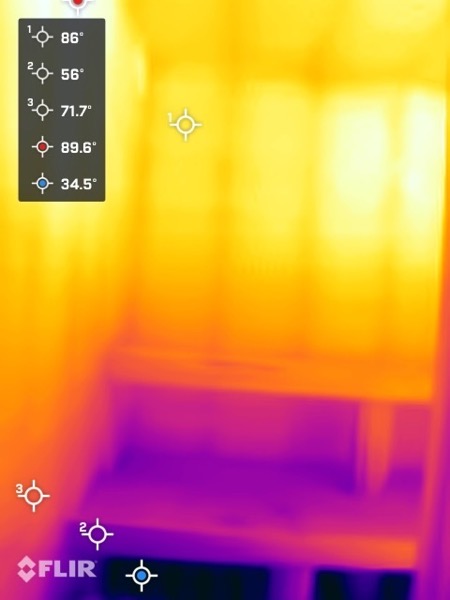
Ambient air head temp (official sauna temp) averaged ≈93°c for the time we were there. The head temp at the wall surface was 86°c which is slightly higher than would normally be expected for a 93°c ambient air temp, but this likely due to good insulation (plus warmer temps outside).
Two critical things to notice in this next image. The face of the foot bench is 56°c which is about what ambient air temp was at that strata and measured at 59°c just above the foot bench.
The wall to the left of the foot bench however is 71.7°c. This is due to radiant heat from the Kuuma that’s hitting it nearly perpendicular. Normally the wall would be slightly cooler, about 52-54°c perhaps, than ambient air temps and the bench due to energy loss to outside.
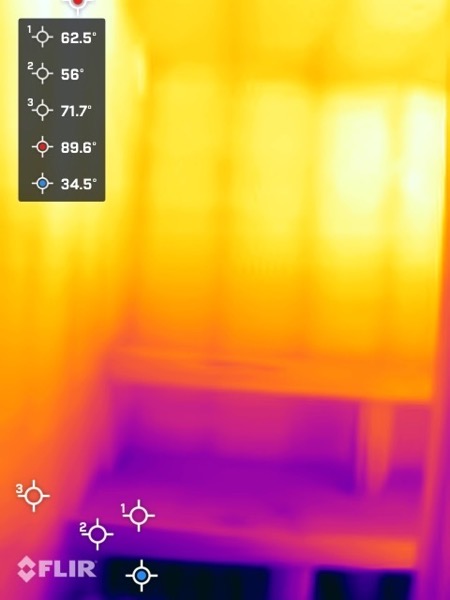
Here I moved point #1 down to the top of the foot bench where it’s indicating about 62.5°c. I’m not sure why this small area is so much hotter. I don’t think conduction. Likely radiant reflection from the wall on the left? A brief downdraft of hot air is also possible though not probable?
Measured Temps:
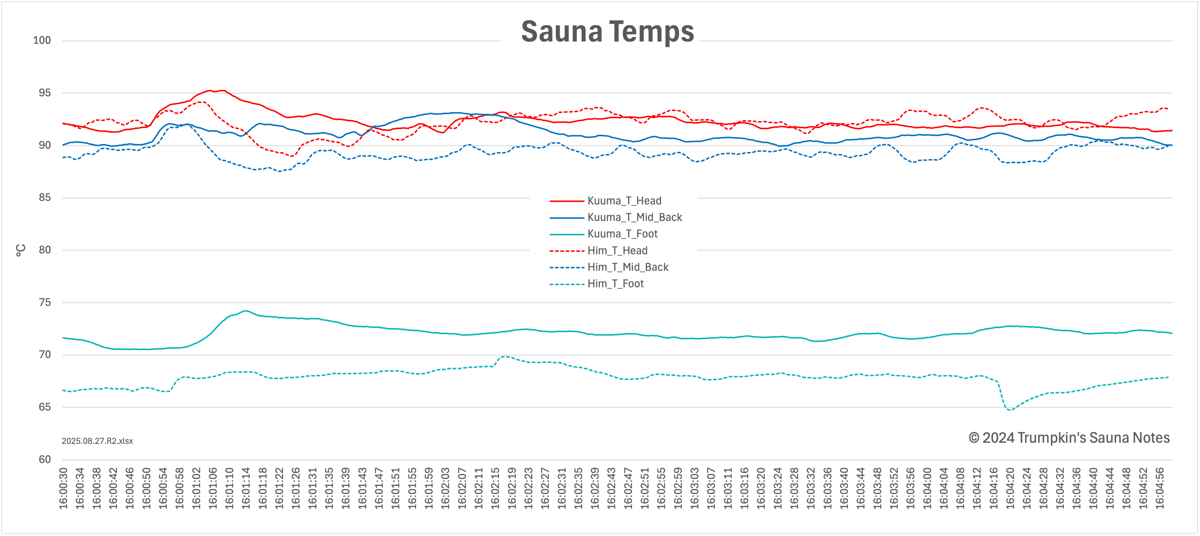
These charts compare W121 with my sauna heated by a Helo Himalaya.
Sensors for W121 were placed on the end wall (on the left in the IR image above) as far from the heater as possible and arrayed vertically just in front of the foot bench. Head (1m above sitting) and Mid_Back I believe indicate accurate temps.
Foot temps are not accurate, likely due to radiant heat on the sensor. Actual air temp at the foot bench with a radiant protected probe was about 57°c which agrees with the temps we see on the bench and our experience of cold feet but with radiant on them from the stove.
The wall where the sensors were is receiving a good bit of radiant heat from the Kuuma which is why it’s so much hotter than the foot bench. The sensors on this wall, particularly the foot level, would have been affected similarly.
It is interesting that the foot temp saw a rise of about 3°c begin about 12 seconds after steam was created yet there was no corresponding increase in steam content at this sensor (2nd chart). For this to have been ambient would have required a blast of air about 17°c hotter than existing. There’s no increase in absolute humidity so this doesn’t appear to have been steam that was pressure driven down this wall (furthest from the heater). A blast of radiant then is the most likely cause though I’m unsure what would have caused it. Possibly the stove suddenly reheating after making steam?
Steam:
In both cases below steam was created with approximately 300ml of water. The Helo Himalaya was from one 300ml ladle while I had to do three ladles, one after the other, of 100ml each for the Kuuma which resulted in three tranches of steam.
Note that in both saunas feet are below the stones and as expected steam fails to adequately descend around bathers feet.
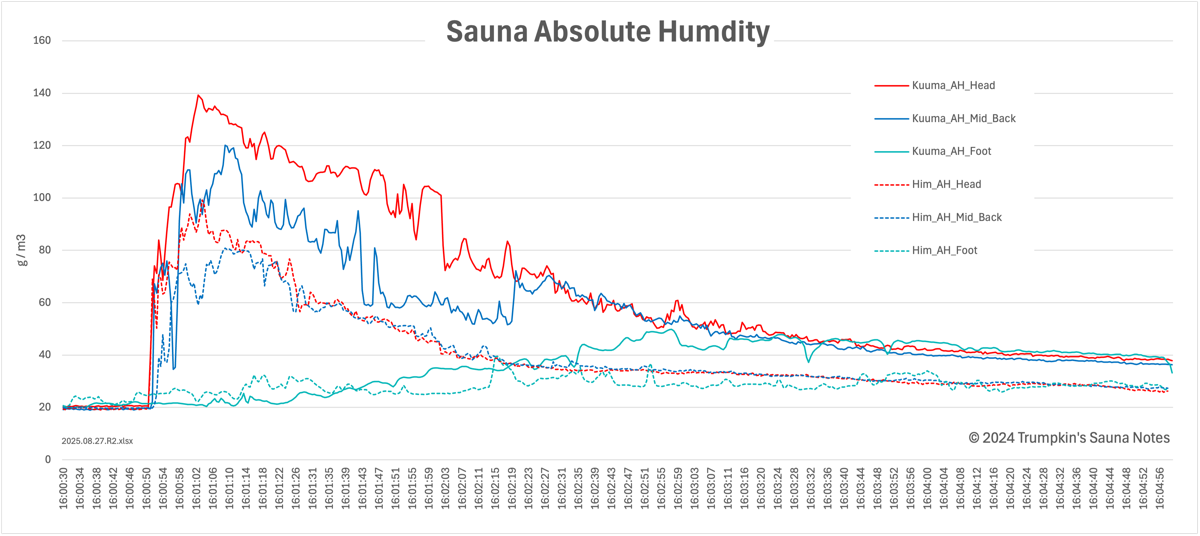
I was surprised that the attack and decay was so similar between the two given the different experiences. The experience is of a much faster and ‘biting’ attack with Kuuma’s, including this one, compared to the Himalaya and other sauna heaters that have a more gentle attack. The Kuuma attack would likely have been steeper with a single pour rather than three separate.
My guess is that the experience difference is due to the temperature of the steam rather than attack rate. I think the only way to determine steam temp is to measure the temps above the stove when steam is made and calculate rough steam temperatures from that.
The Kuuma steam remains, similar to banya’s, more stratified for a longer period which indicates likely hotter steam. The steam from the Himalaya descends down to mid_back and evens out faster, in about 19 seconds, compared to the Kuuma steam that remained largely near the ceiling and didn’t even out between these two points for 74 seconds.
I’m thinking that the mid_back strata for the Kuuma (blue) was steam that was 100°c (not superheated) so ‘normal’ buoyancy and behaving like steam in a normal sauna, while the head sensor is steam that was superheated and so more buoyant. Thus the interesting stratification for the Kuuma. This matches with the experience of very hot around our heads & shoulders for a minute or so and then evening out down to about our navels.
Below (all six Himalaya sensors) we can see that the steam from the Himalaya had descended to and evened out with low_back within 29 seconds, sitting by 40 seconds and calf by 62 seconds, all before the Kuuma had reached the mid_back.

This increased stratification of the Kuuma steam is noticeable (as is the lack of steam around our feet in the Himalaya sauna). There are actually three somewhat noticeably distinct tiers of; superheated steel steam, normal steam, and no steam.
As Ted pointed out, the total amount of steam should total to be about the same for each sauna/heater given both were made with about 300ml of water. My sauna (Himalaya) is slightly larger volume which accounts for some of the difference. Another likely reason for the discrepancy is that the Kuuma is basically a sealed stone tray so for the most part 100% of the water poured on will become steam. The Himalaya is open sided and effectively open bottomed so some water will flow through without becoming steam. This though doesn’t seem like it’d make as large of a difference as we see. Another possibility is that the 100ml ladle was actually larger than labeled. Maybe I need to start carrying my own ladle around with me 🙂
Additional… Actually, that’s not true. We’d need a near infinite number of sensors for the measurements to be anywhere near accurately additive. When AH_Head measures 80g/m3, that’s just for that one spot. 20cm in either direction could be 30g/m3.