
A Pretty Good Sauna
These are the things that people in Finland and elsewhere have learned, over the past century or three, are critical to a good sauna experience. Each one of these has a reason and each contributes to a better sauna experience. These are the basics that have been proven over time.
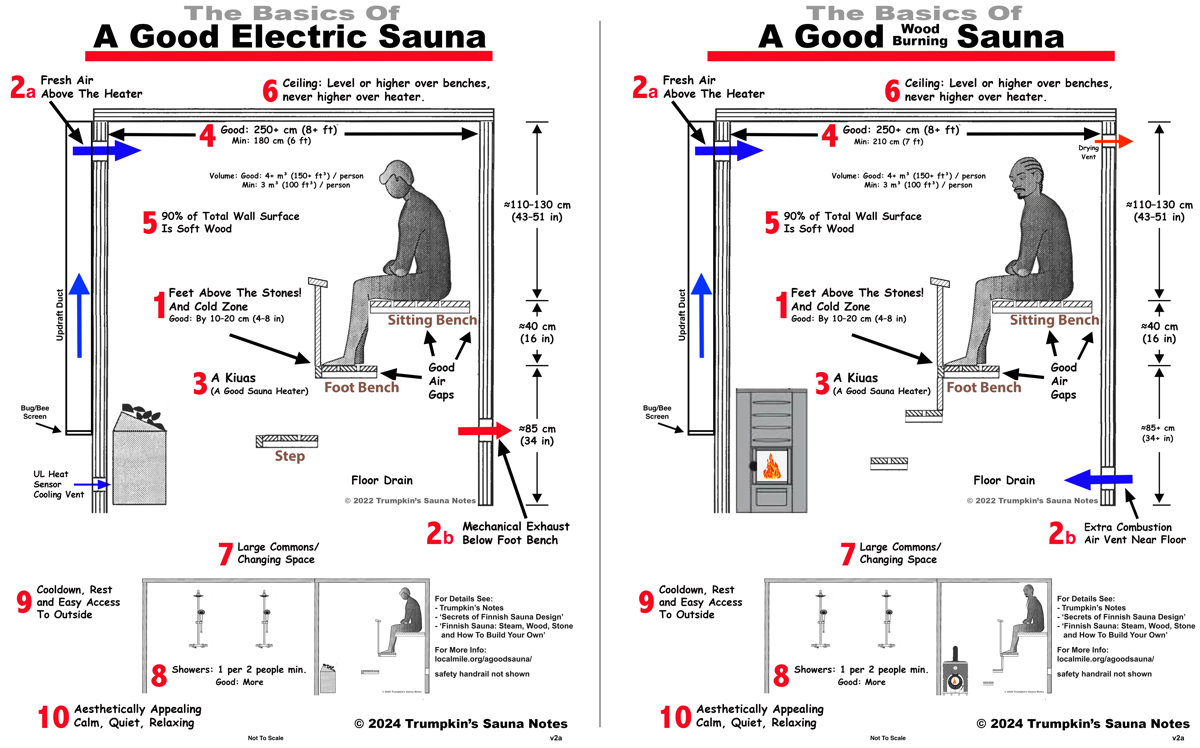
The following is a brief high level overview. For critical details see; Trumpkin’s Notes and Lassi’s books ’Secrets of Finnish Sauna Design’ and ‘Finnish Sauna: Steam, Wood, Stone and How to Build Your Own’.
1 – Feet Above The Stones (and Cold Zone). People in Finland call this ‘The First Law of Löyly’. For good reason.
Hot air and steam rise, colder air sinks – stratification.
Good heat (within ≈20% of head temp) does not descend in to the cold zone (lower third of volume) and rarely goes below the top of the stones.
Steam does not descend below the top of the stones except in very specific circumstances of larger spaces.
For a good sauna experience of even heat and steam head to toes we want our entire body, and thus the foot bench, above the top of the stones, ideally by 10-20cm (4-8”). This area is known in Finland as löylytasku or löyly pocket.
If the foot bench is too low, if our feet are more than about 20% cooler than our head or steam doesn’t fully envelope our feet then people in Finland and elsewhere call this ‘cold feet’. It is mildly uncomfortable but over time becomes a significant irritant that reduces enjoyment (and health benefits).
For hygiene and odor control we also want the foot bench high enough to maintain a temperature of at least 55-65°c to kill bacteria.
2 – Ventilation. Ventilation is critical for several reasons; 1) Remove exhaled CO2 and provide fresh air to breathe, 2) Remove steam (so that we can do it again), 3) Remove VOC’s and other airborne gook, and 4) a bit of cooler air keeps electric heaters working more which keeps the stones hotter for better steam.
For Electric heated saunas and wood fed from outside the hot room, Mechanical Downdraft Ventilation works well. Natural convection rarely works.
For Wood heated saunas, a combination of natural downdraft and traditional combustion air supply is often the best option.
Note that for this to work properly the sauna should be fairly well sealed with little to no air entering anywhere except the designated vent(s).
An updraft duct or other back flow scheme is a critical element for the fresh air supply.
All fresh air supplies and passive exhausts should be adjustable.
3 – Heater and Stones. The hot stones are the heart of a sauna, they are what make a sauna a sauna. This is also what differentiates a sauna from other forms of sweat bathing.
Sauna heaters are specialized heaters which is why people in Finland have a special name for them – Kiuas. They are different from a wood stove and it’s just about impossible to convert a wood stove in to a Kiuas. A sauna heater has 4 key purposes;
- Heat The Stones. To at least 150°c though 200-400°c is best.
- Produce a convective loop of hot air in the sauna created from airflow up through the stones.
- Produce steam from the stones (and as little from steel as possible).
- Produce no noticeable radiant heat on bathers.
Since we need our foot bench to be above the stones, the heater should also not be too tall which is why open sided tower heaters are not recommended. And no, despite marketing claims, steam does not go below the top of the stones of these.
4 – Size and Volume. About 180 x 180 x 235cm (6’ x 6’ x 7’-8”) is the smallest that will work acceptably well for electric (though this really has breathing volume for only 2 people). Wood heated saunas should have a minimum of about 210cm (7’) heater wall to bench wall.
Larger is better but smaller results an an increasing decline in the experience with increasingly uneven temps and steam, noticeable radiant from the heater, lessor air quality for breathing, feelings of claustrophobia, etc. Smaller can also make it difficult to have comfortable steps up to the benches. The width can be decreased a little but decreasing the other dimensions has greater negative impact.
5 – 90% Soft Wood. About 90% of the walls, and all of the ceiling, should be soft wood. The hygroscopic properties help to soften humidity changes for a more comfortable experience. The wood also helps to reduce noise and echo.
Spruce and Pine are good options. Cedar not so much.
Some of this being masonry, cement is OK though not desirable.
Glass is the big caution here. Not so much because of energy loss, which there is, but because of increased stratification and radiant resulting in a harsher environment. Windows are good but it’s best to keep them to no more than maybe 20% of one wall.
6 – Ceiling Shape. We want the convective loop to flow smoothly and avoid heat traps.
Flat works well but the ceiling can also be sloped slightly upwards from the heater to over the benches or be slightly barreled, vaulted or panned. Wall to ceiling angles of less than 90° should generally be avoided to encourage good airflow – some simple cove or similar along the ceiling can help.
Avoid having ceilings higher over the heater than over the benches and especially avoid a wall to ceiling angle of less than 90° above the heater. This not only for good airflow and a good sauna experience but heat getting trapped above the heater increases fire risk.
Hot – Cold – Rest – Rinse – Repeat
Sauna is more than just the hot room. It’s a routine of multiple rounds of alternating hot and cold. Hygiene is also important so we want to insure that we can easily rinse off between rounds. For a good experience we need to adequately provide for this.
7 – Large Commons/Rest/Changing/Shower. This serves several important functions;
- Airlock to lessen cold air from entering the sauna and hot air from escaping.
- Pre-Warm. It’s best to warm our body to about room temp before entering the hot room. Going directly from cold outside isn’t so comfortable and may be unhealthy.
- Showers to rinse off before we enter the sauna and to rinse sweat off before we go out in to cold air.
- A place to rest, relax and hydrate between rounds in the hot room. And yes, also a place to change and hang our clothes.
- Storage for cleaning and maintenance supplies.
This space is typically 2x to 3x the size of the hot room. If in a temperate climate then this isn’t so necessary and outside can serve this purpose.
For a really tight budget, plan for adding this later. Space for it (and a covered porch) as well as building the sauna hot room to allow the future commons area to be easily tied in to the structure.
8 – Showers. We should always rinse off each time before entering the sauna and with soap before the first round. We don’t want to drag our bacteria and BO in to the sauna with us. And others want this for us even more.
It’s also more comfortable to be able to rinse sweat off before going outside in to cold air, particularly after the first round. Otherwise we’ll end up with salt and bacteria dried on to our skin which is not very comfortable.
Traditionally people in Finland kept full water buckets for this and many still do today, especially in off-grid wood heated saunas.
In temperate climates showers can be outside. In less temperate they should be inside or ideally have some of both.
9 – Cooldown, Rest, Easy Access to Outside. The sauna should be located so that it’s easy to exit the sauna, rinse in a shower and then go outside to cool down. All while dripping wet.
10 – Aesthetically Appealing, Calm, Quiet, Relaxing. Aesthetics plays a critical role in our enjoyment, relaxation and health. And this is very much in the eyes of the beholder. Some people prefer a more rustic space and others like finer detailed woodwork.
The thermal area should be calm and quiet. A place we enjoy and can be comfortable spending 4 or more hours several days per week.
———-
These are the standards that people in Finland, with much more experience than any of us, have found are critical to a good sauna experience. These are the saunas that provide a compelling experience that people enjoy for decades rather than enjoying only until the novelty wears off.
Lines In The Sand
The minimums are for a minimally compelling sauna. One that will satisfy most people long-term. Not necessarily good, but good enough. The farther you go below these guidelines the more likely you are to notice uneven heat, weaker löyly, radiant heat, cramped access or other issues.
Individuality – We are all different. Some people are happy with a little barrel sauna for decades. Most though will tire of it and it’s problems within a few years.
Time – Many of these are things that we don’t really notice per round even though a bit lessor experience. Over time though that bit lessor experience adds up.
Novelty and Abandonment – Everyone loves their new sauna when they first use it. Over time though, as the novelty wears off, people with lessor saunas can find the experience less than compelling.
Money – A sauna, good, bad or ugly, is going to cost us several thousands of €’s, £’s, or $’s. That’s a lot of money. What we don’t want to do is spend all of that money for something that misses the mark and that we’ll abandon using after 3 years. That’s a lot of money to send down the drain.
Much better to build something that we’ll enjoy for a decade or three.