
[DRAFT]
We know that sauna design affects bather enjoyment. A larger space, higher benches and good ventilation result in a compelling sauna experience that people can’t wait to do again and that they will continue to enjoy for decades, while smaller spaces, lower benches and poor ventilation result in saunas that are not so well enjoyed and in some cases even ’not well tolerated’.
A ‘Sauna’ ≠ Sauna
Sauna design and the resulting sauna environment also have an effect on physiological response and health/wellness/recovery benefits. Due to the extreme heat and steam stratification for example, a small box with low benches and poor ventilation that’s typical in the U.S. appears to result in about 1/5 to 1/10 the increase in core body temperature of a proper sauna with feet above the stones and good ventilation that’s typical in Finland.
And critically, a proper sauna is both the most enjoyable experience and likely the most beneficial – a twofer.
Knowing the details of the saunas and other thermal interventions used is critical to furthering our understanding of these modalities. Sauna physics and human physiology are critically interlinked parts of a system and neither should be ignored.
Helping Consumers – This information will also help consumers to avoid being victims of ignorant or unscrupulous sales and marketing folks, bloggers and podcasters who promote all manner of things as ‘saunas that provide numerous health benefits’. Just because it’s called a ‘sauna’ doesn’t mean that it is nor that it will deliver any health benefits – these details matter.
We need the medical community to help separate the wheat from the chaff.
One System: Sauna Physics To Physiological Response
A proper sauna environment with low stratification and good ventilation can provide an increase in Tcore of perhaps ≈1.1 – 1.8°c after 15 minutes of exposure while a small, low bench, poorly ventilated Finnleo kit ‘sauna’ results in less than 0.2°c in 10 minutes.
This due primarily to stratification. In a well designed sauna a bather will be exposed to perhaps 90°c at their head and 76°c at their feet for an average of 83°c across their body. A Finnleo kit, even when actually 90°c at bathers heads is only about 55°c at their feet for an average of about 72°c.
The sauna environment is determined by two things; 1) the physical design that affects things like how even the heat and steam are and how fresh the air is and is for the most part fixed for a particular sauna and 2) the setup such as the desired temperature and humidity that can be varied from session to session.
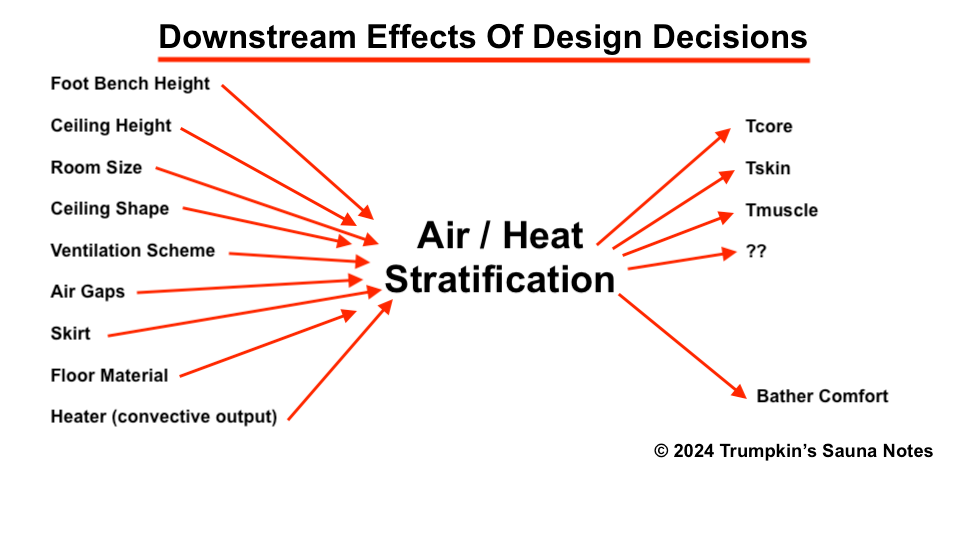
This sauna environment then affects both physiological response and bather comfort. Less stratification for example results in both increased bather comfort and likely a higher Tcore.

Bather comfort has further downstream effects. It may indirectly affect physiological response. It very often affects frequency of use as well as longevity.
For stratification alone we can see that there are numerous design elements that will affect how much heat and steam stratification we have and this in turn affects physiological responses and bather comfort. This can be repeated for numerous sauna environmental elements such as air quality, steam quality, etc.
Good ventilation that results in lower CO2 and better overall air quality for example will allow bathers to be more relaxed and will result in a more comfortable, enjoyable and compelling environment. Instead of a sauna that is noted as not well tolerated and that people won’t want to do as often or at all, we’ll have one that people thoroughly enjoy being in and want to enjoy frequently for decades.
Physiological response likely affects comfort as well. A higher Tcore appears to make cold plunge after a sauna more enjoyable and tolerable. I and others have noticed that a cold plunge after a proper sauna is much more enjoyable than after a barrel or small kit.
So it’s important to know both the design parameters of the sauna as well as how it is set up. This in turn will provide for better knowledge of physiological outcomes, better sauna designs and more accurate and honest consumer information.
Documenting The Sauna:
Some key design elements (most critical in bold) that can make a difference and that are important to know include;

Photos: showing all walls, foot bench relationship to heater, ventilation supplies and exhausts, thermostat sensor location, locations of measurement sensors.
Measurements
Temperatures, humidity and CO2 levels vary considerably within a sauna. For example, a thermostat mounted on the heater wall can provide readings 50-70% higher than actual sauna temperatures (1m above the sitting bench) and 2x to 3x higher than bathers feet on the foot bench. So where measurements are taken within the sauna is critical. Just saying that a sauna is 90°c is almost meaningless without knowing where it was 90°c.
There are a number of measurements of the sauna environment that are important. The two most critical are the official sauna temperature and temperatures at the foot bench.
- Official Sauna Temperature – Taken on the bench wall, 1m above the sitting bench, at least 20cm from either corner and 5-10cm out from the wall. This latter to avoid the cold layer of air next to the wall.
- Feet Temperature – Taken approx 2-5cm above the foot bench and some distance from the heater.
These can vary considerably over time so it’s best to log the measurements (≈ 1 sample / minute). Then calculate an average during the exposure time if appropriate.
Absolute Humidity (g/m3) and CO2 are also helpful, particularly if logged over time.
Conclusion
Hopefully this can start a conversation that will lead to more robust and accurate reporting of sauna and other thermal interventions used in medical research and provide a framework for researchers to use on an interim basis.
Some of this same rigor should be applied to other modalities such as steam baths, laconiums, tepidariums, etc.
Revisions:
2025.07.31 – First Draft
2025.09.08 – Second Draft