For Internal Use Only. International Sauna Association, Sauna Dynamics Group. Please keep this document, the name of the business if you know it and all images confidential.
I visited a new log sauna that was just completed a couple of months ago. In summary; good culture, good aesthetics, good location, bad sauna, questionable other facilities. The sauna experience was actually worse than many barrels.
General Observations
Overall Facility – Out in the countryside. There are several buildings; Reception, Outhouse, Maintenance and Saunas. The reception building includes a small living room with a table and six chairs along with a sofa. Two small (1m x 1m ?) changing rooms and office. The 2 hole outhouse is one of the nicest/cleanest I’ve seen. The whole place exudes a nice rustic charm.
Lots of gravel/dirt/mud walking paths that could be improved and piles of building materials and other detritus should be removed/hidden. No good options for rest/relax.
Reception / Hostess – Quite wonderful. Friendly and wanted to insure that everyone enjoyed their visit and understood how to use a sauna properly.
Weather – Temp 36°f / 2°c, Wind 9 mph / 14 km/h official though less in this area protected by trees, sunny with a few clouds.
I was on a very tight time schedule so unfortunately did not have time to take many photos.
Observations – The Log Sauna
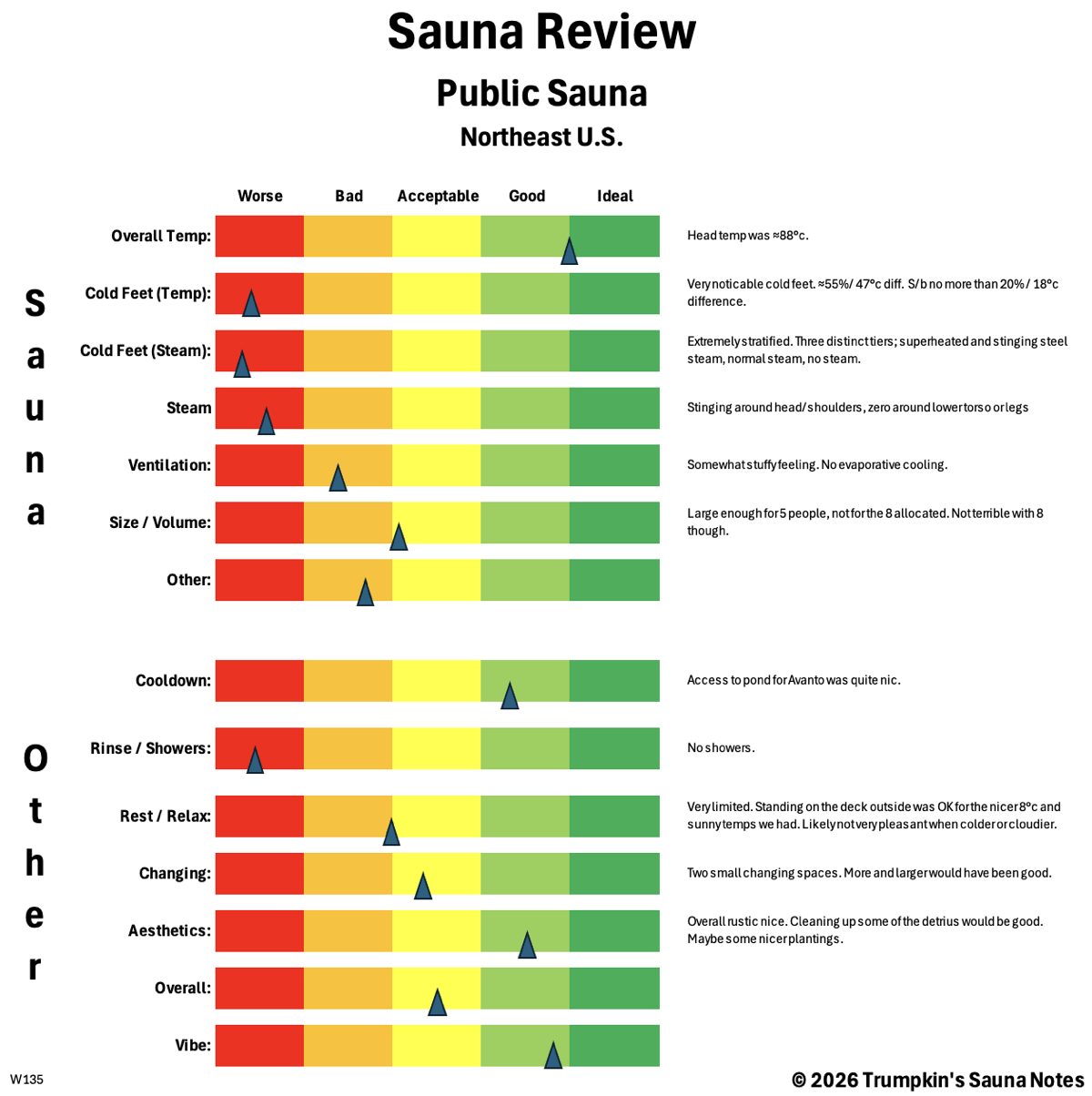
There were eight of us sharing this one sauna for 90 minutes. Two young couples (mid 30’s), three twenty-something gals and me. Overall everyone had a quite good sense of sauna etiquette and routine. We squeezed in three hot-cold rounds in our tight 90-minute time slot. Overall an enjoyable time except for the very poorly performing sauna hot room.
The sauna building was constructed of ≈200mm thick logs and included an approx 250 d x 360 w x 215 h hot room heated by a Kuuma Blue Flame and 190 x 360 commons/changing. There was a wood walkway around two sides with steps down in to a sandy bottom pond for cold plunge.
The hot room air was stagnant with no discernible air flow which resulted in limited evaporative cooling of skin, increased stratification and elevated CO2 levels.
Stratification was significant. Head temp was 88°c, sitting bench 64°c and feet 37-41°c (about 29°c cooler than it should have been). Even pulling feet up on to the sitting bench left bathers with cold feet.
Radiant from the stove was moderate. Experientially, less than a Kuuma Original/Legacy, more than a Harvia M3 and much more than most sauna heaters. There was a minor seating problem as some people didn’t want to sit on the bench closest to the stove due to the radiant so we were a bit squeezed in the far end. Sitting on the end furthest from the stove there was noticeable radiant on our feet and shins, noticeable but minimal on our faces.
Steam was significantly stratified with three very discernible tiers;
- Superheated steel steam at the top. Very hot / stinging steam that never descended below shoulders.
- Normal stone steam below the superheated. This extended from just below shoulder down to about navel.
- No noticeable steam below navel.
As we’ve seen before with other Kuuma’s the three tiers are fairly distinct though this was the most noticeably delineated I think I’ve experienced. There was a noticeable line across my upper chest, above which was stinging steel steam and below was normal stone steam. And it stayed like this for about 2.5 minutes until most of the steam dissipated.
Steam was removed somewhat quickly each time. Not as fast as a Finnish/Continental sauna but faster than most North American. The somewhat slower timing of removal would have been fine with normal sauna steam but was a bit long with the biting steel steam around our heads and much greater stratification.
Due to the heat and steam stratification our core did not seem heated as well as in a good sauna with even temps and steam. This affected cold plunge enjoyment. The initial shock was similar but you didn’t acclimate as quickly and cooled off faster after exiting compared to after a better sauna.
Analysis:
Stratification:
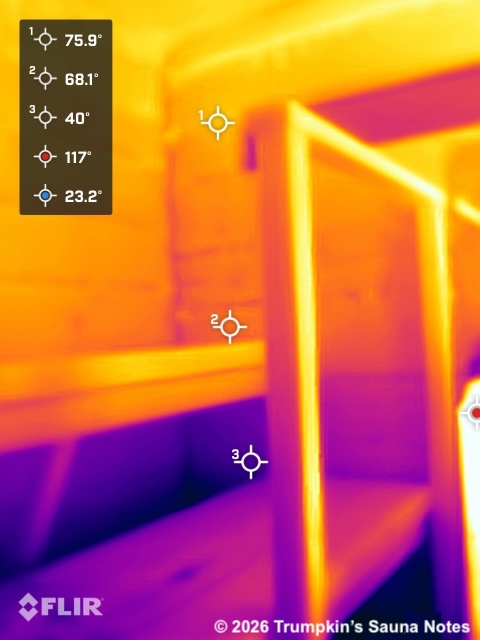 East Wall (heater on right)
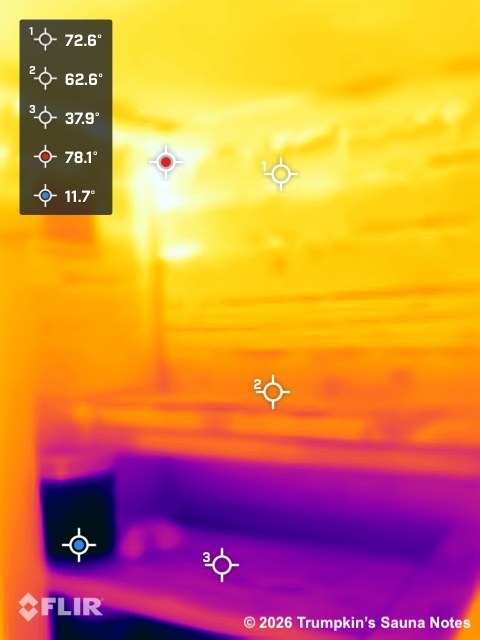 West Wall
Actual head temp was about 88°c. Feet were nearly 50°c cooler than head so about 31°c cooler than they should have been. Besides being uncomfortable for bathers and likely not delivering health benefits, the low surface temperature on the foot bench will not kill mold and bacteria.
Likely causes of very cold toes;
- Low Benches. As typical, this was likely the primary cause.
- Poor Convective Loop. As we’ve seen with heavy steel stoves like this elsewhere, the lack of a good convective loop results in increased stratification over heaters that produce a good convective loop that decreases stratification within the löyly pocket. My guess is that about 6-10°c of the 31°c shortfall was due to this.
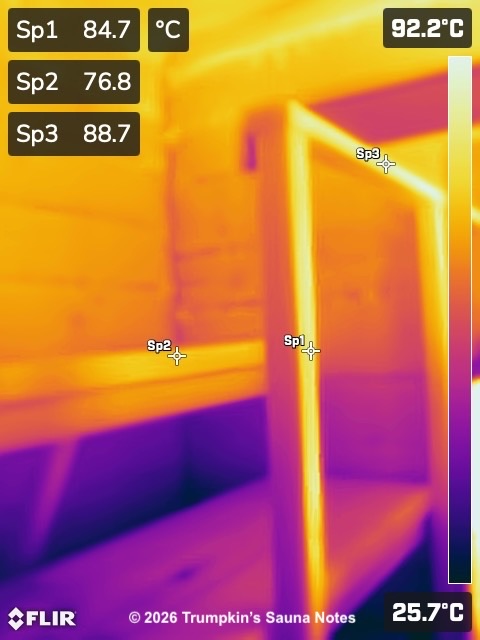
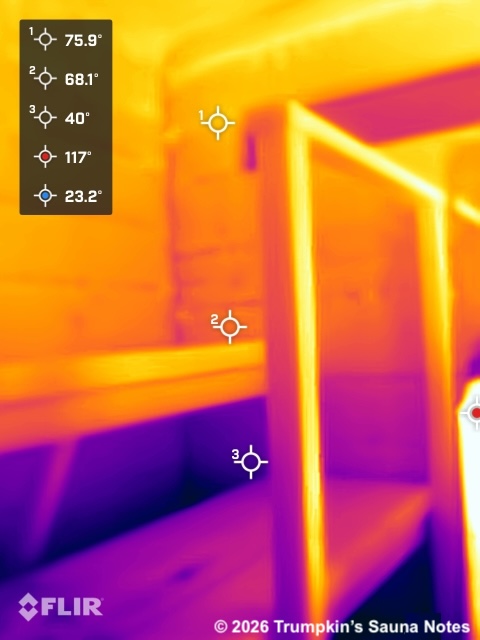
- Poor Air Gaps in the benches and between the sitting bench and bench wall. Note in the East Wall photo below the very clear line extending out from the sitting bench. There’s about an 8°c difference over about 15 cm. This is likely due to a combination of top of the stones and the lack of air gaps in the sitting bench.
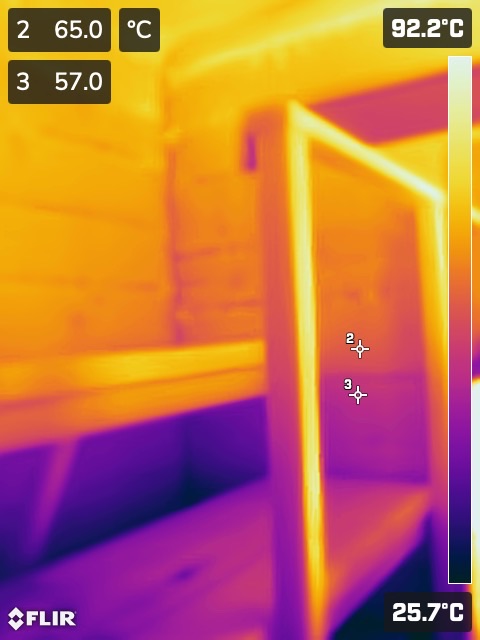 East Wall – Stratification line at sitting bench and top of stones.
There’s about a 5-6°c difference between the east and west locations within the hot room for each strata. I’m not sure how much of that is radiant from the heater and how much is convective heat. The east wall, which is hotter, was also shaded on the exterior while the cooler west wall appears to be heated by the sun so that actual heat flux difference is likely greater.
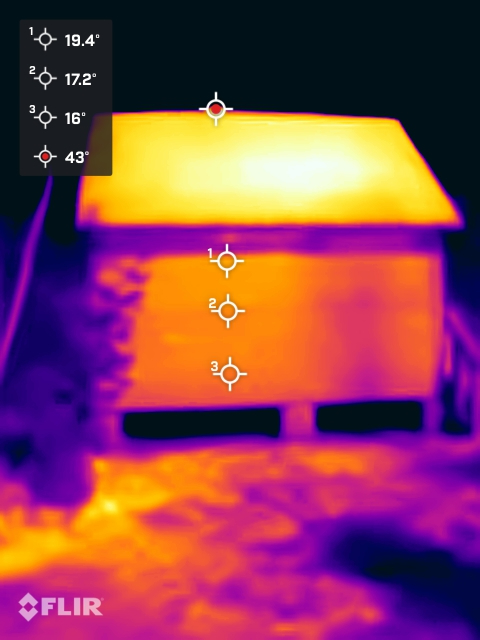 West Wall Exterior
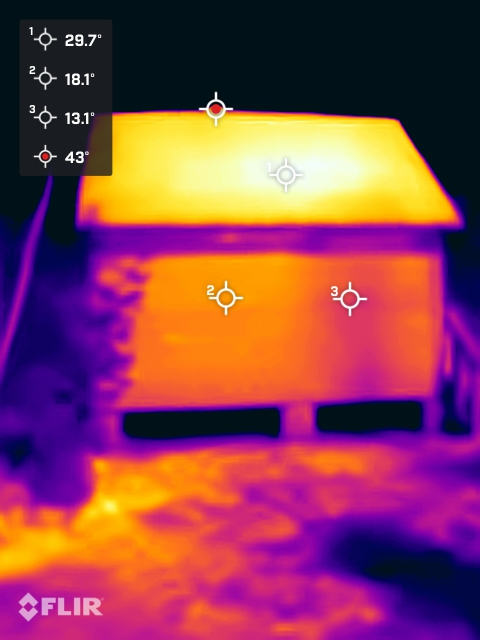 West Wall Exterior (hot room on left, commons on right)
Not unexpectedly there appears a good bit of heat loss through the solid timber walls as evidenced by IR wall vs measured convective temps. A nearby stick framed sauna was 7°c cooler on the exterior even though 13°c hotter head temp. HOWEVER, we are likely looking at radiant from the sun more than heat from inside. The cooler top of the wall seems to align with the sun’s shadow more than any interior ceiling and the cooler exterior of the commons space that looks very much like it’s cooler because it’s the cooler commons also aligns with some minimal tree foliage. I’m going to call this one natural radiant. I wish I’d taken time to do the shaded walls to see what they look like.
Also, the bit of hot ground stretching towards the lower left of the exterior images is interesting.
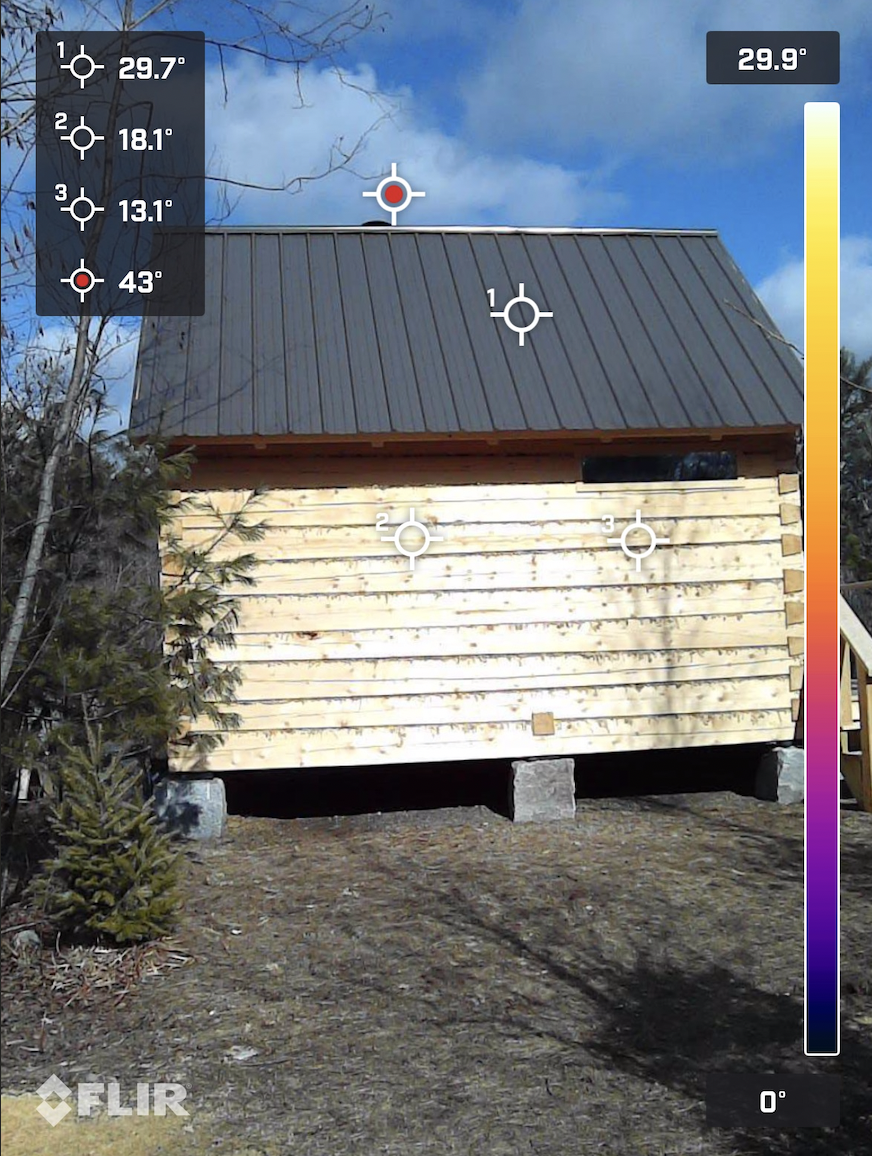 West wall exterior. Note that this image is slightly lower than actual IR so measurement points appear slightly higher.
Moss chinked joints seem to be performing well.
Radiant:
We’ve seen a lot of radiant from these stoves before so no need to spend much time on it again. And this is also a more minor problem compared to the lack of a convective loop and the steel steam.
On the east end… While convective temps on bathers shins at this strata was 62°c, radiant was between 84.7°c and 76°c.
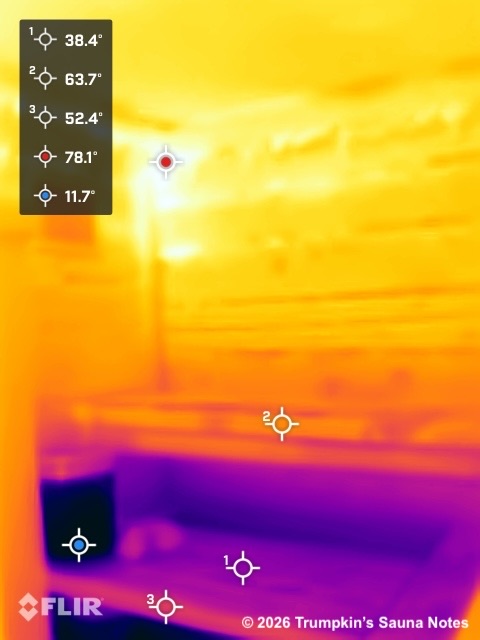
On the west end… The foot bench is 38.4°c which was likely a fairly accurate ambient temp but radiant on our feet was about 52.4°c.
Heater:
The Kuuma Blue Flame stones were an average of about 117°c. The hottest spot in the stones area is 275°c where you could see through to the steel. Aside from that one spot the hottest stone was 198°c. Better than Kuuma Original/Legacy but below the 150-200°c minimum average needed.
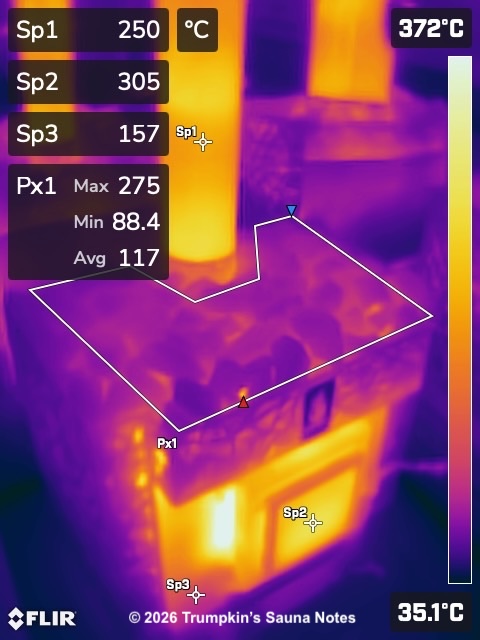
The Kuuma produced no discernible convective loop. This caused the stagnant air problems and contributed to the significant stratification. Based on other saunas with similar bench and stone elevations I’d guess the lack of convective airflow contributed about 8-10°c of the 31°c of excess head to toes stratification and also contributed to greater front to back difference.
The unheated stones and limited stone depth combined to produce the steel steam. Most water flowed through the stones to the steel with much of it then becoming superheated steel steam.
The low benches and ceiling contributed to both heat and steam stratification. Even if the benches had been above the stones (e.g., foot bench at what is currently sitting bench level) there would still have been significant convective heat and steam stratification due to the lack of a good convective loop and the presence of steel steam.
Summary
One major room problem is the benches and ceiling being too low. There may be a ventilation problem as well but other problems were so bad that this was off the bottom of my list.
Three major problems from the heater; 1) poor convective loop, 2) steel steam, and 3) too much radiant.
To earlier conversations… The heater itself is problematic. No amount of room fixes or blocking of radiant can overcome the lack of convective loop and the presence of steel steam.
Questions and Conundrums
1) One interesting thing is that there seemed to be more superheated steel steam and more distinctive tiering with this and another Blue Flame than with Kuuma Original/Legacy stoves. Given the stones here are about 10°c hotter on average I would have expected the opposite.
One possibility is that the steel hot plate on the Blue Flames is significantly hotter than on the others resulting in the greater amount of steel steam (and the slightly hotter stones). Design or coincidentally hotter fires?
2) The significant amount of radiant on the front edge of the sitting bench next to the stove and on the foot rail. Yet not nearly so much on the front edge of the foot bench.
3) Is the 5-6°c difference between east and west radiant or convective?
4) Steel steam is positive ions (vs negative ions for stone steam). Does this make a realistic difference?